Monday, March 16, 2015

Alcohol or Marijuana? A Pediatrician Faces the Question


As my children, and my friends’ children, are getting older, a question that comes up again and again from friends is this: Which would I rather my children use — alcohol or marijuana?
The immediate answer, of course, is “neither.” But no parent accepts that. It’s assumed, and not incorrectly, that the vast majority of adolescents will try one or the other, especially when they go to college. So they press me further.
The easy answer is to demonize marijuana. It’s illegal, after all. Moreover, its potential downsides are well known. Scans show that marijuana use isassociated with potential changes in the brain. It’s associated with increases in the risk of psychosis. It may be associated with changes in lung function or long-term cancer risk, even though a growing body of evidence says that seems unlikely. It can harm memory, it’s associated with lower academic achievement, and its use is linked to less success later in life.
But these are all associations, not known causal pathways. It may be, for instance, that people predisposed to psychosis are more likely to use pot. We don’t know. Moreover, all of these potential dangers seem scary only when viewed in isolation. Put them next to alcohol, and everything looks different.

Photo

Andy Eidinger, chairman of the D.C. Cannabis Campaign, held a joint on Feb. 26, on the first full day of marijuana legalization in Washington.CreditRobert Macpherson/Agence France-Presse — Getty Images

Because marijuana is illegal, the first thing I think about before answering is crime. In many states, being caught with marijuana is much worse than being caught with alcohol while underage. But ignoring the relationship between alcohol and crime is a big mistake. The National Council on Alcoholism and Drug Dependence reports that alcohol use is a factor in 40 percent of all violent crimes in the United States, including 37 percent of rapes and 27 percent of aggravated assaults.
No such association has been found among marijuana users. Although there are studies that can link marijuana to crime, it’s almost all centered on its illegal distribution. People who are high are not committing violence.
People will argue that casual use isn’t the issue; it’s abuse that’s worrisome for crime. They’re right — but for alcohol. A recent study in Pediatricsinvestigated the factors associated with death in delinquent youth. Researchers found that about 19 percent of delinquent males and 11 percent of delinquent females had an alcohol use disorder. Further, they found that even five years after detention, those with an alcohol use disorder had a 4.7 times greater risk of death from external causes, like homicide, than those without an alcohol disorder.
When I’m debating my answer, I think about health as well. Once again, there’s no comparison. Binge drinking accounted for about half of the more than 80,000 alcohol-related deaths in the United States in 2010, according to a 2012 report by the Centers for Disease Control and Prevention. The economic costs associated with excessive alcohol consumption in the United States were estimated to be about $225 billion dollars. Binge drinking, defined as four or more drinks for women and five or more drinks for men on a single occasion, isn’t rare either. More than 17 percent of all people in the United States are binge drinkers, and more than 28 percent of people age 18 to 24.
Binge drinking is more common among people with a household income of at least $75,000. This is a solid middle-class problem.
Marijuana, on the other hand, kills almost no one. The number of deaths attributed to marijuana use is pretty much zero. A study that tracked more than 45,000 Swedes for 15 years found no increase in mortality in those who used marijuana, after controlling for other factors. Another study published in the American Journal of Public Health followed more than 65,000 people in the United States and found that marijuana use had no effect at all on mortality in healthy men and women.
I think about which is more dangerous when driving. A 2013 case-control study found that marijuana use increased the odds of being in a fatal crash by 83 percent. But adding alcohol to drug use increased the odds of a fatal crash by more than 2,200 percent. A more recent study found that, after controlling for various factors, a detectable amount of THC, the active ingredient in pot, in the blood did not increase the risk of accidents at all. Having a blood alcohol level of at least 0.05 percent, though, increased the odds of being in a crash by 575 percent.
I think about which substance might put young people at risk for being hurt by others. That’s where things become even more stark. In 1995 alone,college students reported more than 460,000 alcohol-related incidents of violence in the United States. A 2011 prospective study found that mental and physical dating abuse were more common on drinking days among college students. On the other hand, a 2014 study looking at marijuana use and intimate partner violence in the first nine years of marriage found that those who used marijuana had lower rates of such violence. Indeed, the men who used marijuana the most were the least likely to commit violence against a partner.


Most people come out of college not dependent on the substances they experimented with there. But some do. So I also consider which of the two might lead to abuse. Even there, alcohol fares poorly compared with marijuana. While 9 percent of pot users eventually become dependent, more than 20 percent of alcohol users do.
An often-quoted, although hotly debated, study in the Lancet ranked many drugs according to their harm score, both to users and to others. Alcohol was clearly in the lead. One could make a case, though, that heroin, crack cocaine and methamphetamine would be worse if they were legal and more commonly used. But it’s hard to see how pot could overtake alcohol even if it were universally legal. Use of marijuana is not rare, even now when it’s widely illegal to buy and use. It’s estimated that almost half of Americans age 18 to 20 have tried it at some point in their lives; more than a third of them have used it in the last year.
I also can’t ignore what I’ve seen as a pediatrician. I’ve seen young people brought to the emergency room because they’ve consumed too much alcohol and become poisoned. That happens thousands of times a year. Some even die.
And when my oldest child heads off to college in the not-too-distant future, this is what I will think of: Every year more than 1,800 college students die from alcohol-related accidents. About 600,000 are injured while under alcohol’s influence, almost 700,000 are assaulted, and almost 100,000 are sexually assaulted. About 400,000 have unprotected sex, and 100,000 are too drunk to know if they consented. The numbers for pot aren’t even in the same league.
I’m a pediatrician, as well as a parent. I can, I suppose, demand that my children, and those I care for in a clinic, never engage in risky behavior. But that doesn’t work. Many will still engage in sexual activity, for instance, no matter how much I preach about the risk of a sexually transmitted infection or pregnancy. Because of that, I have conversations about how to minimize risk by making informed choices. While no sex is preferable to unprotected sex, so is sex with a condom. Talking about the harm reduction from condom use doesn’t mean I’m telling them to have sex.
Similarly, none of these arguments I’ve presented are “pro pot” in the sense that I’m saying that adolescents should go use marijuana without worrying about consequences. There’s little question that marijuana carries with it risks to people who use it, as well as to the nation. The number of people who will be hurt from it, will hurt others because of it, begin to abuse it, and suffer negative consequences from it are certainly greater than zero. But looking only at those dangers, and refusing to grapple with them in the context of our society’s implicit consent for alcohol use in young adults, is irrational.
When someone asks me whether I’d rather my children use pot or alcohol, after sifting through all the studies and all the data, I still say “neither.” Usually, I say it more than once. But if I’m forced to make a choice, the answer is “marijuana.”
Article

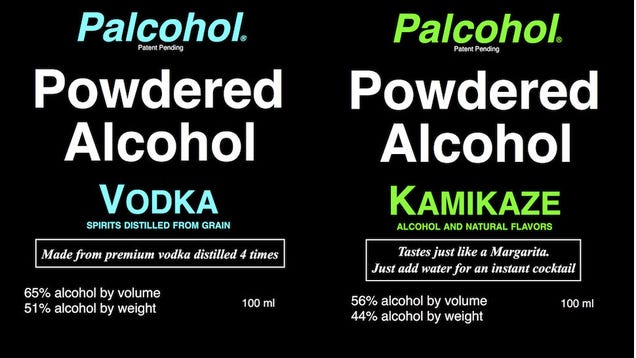
Powdered Alcohol Gets Federal Agency's Approval


NEW YORK — A powdered alcohol intended to be mixed up into drinks has gained approval from a federal regulator.
The product, called Palcohol, had received the greenlight from the Alcohol and Tobacco Tax and Trade Bureau briefly last year before the bureau backtracked and said the label approvals had been given in error.
...
Several states have already moved to ban powdered alcohol, including lawmakers in Colorado who last month advanced legislation to temporarily halt its sale. That bill has since morphed to ensure the regulation of powdered alcohol as if it were liquid alcohol once it gets federal approval.
Concerns have included abuse by minors, the potential to snort the powder and whether Palcohol's light weight would make it easy to sneak alcohol into public events or spike drinks.
Palcohol would come in a pouch, with water being added to the powder inside for the equivalent of an alcoholic drink.
A statement on Palcohol's website says the company hopes to have the product for sale this summer. ..
The four products that have been approved include powdered versions of a cosmopolitan, a margarita, vodka and rum. Phillips added that he expects another Palcohol product — Lemon Drop — should also be "approved shortly."
Previously, Phillips had said he came up with the idea for Palcohol because he wanted a way to enjoy alcoholic drinks after hiking or other activities without having to lug around heavy bottles.
Hogue said the Alcohol and Tobacco Tax and Trade Bureau regularly reaches out to the Food and Drug Administration to get determinations on whether a product might be considered "adulterated." If the FDA says the product isn't adulterated, he said the bureau's evaluation centers on whether labels accurately reflect what's in the product.
"Potential for abuse isn't grounds for us to deny a label," Hogue said.

Wednesday, March 11, 2015

Sex on Different Drugs

Sex_On_Drugs_Intro
This post was originally published on May 5.

Hypothesis

This experiment is about sex on drugs, not sex for drugs. Therefore, I plan to conduct the sexual act in its purest, most apolitical form — while being totally off my head. My goal is to find a dependable accessory to sex.

In other words, I want to find "my drug." It's like when you're 16, and you rummage around in your parents' liquor cabinet trying to determine which drink will be "your drink." (Embarrassingly, mine's still Malibu and Coke.) The question I intend to answer: Is sex on drugs even better than the real thing, or, like the inclusion of "Hotter Than Hell (Demo Version)" on the reissue of Motley Crue's Shout at the Devil, just an unnecessary augmentation of the sublime?

Materials

Viagra (1, 50 mg)
Ecstasy (1, type: "Ninja Star")
Mushrooms
Cocaine ($40 worth)
Marijuana (1 nugget, strain: "Juicy Fruit")
Girlfriend (1)
Method
Mushrooms
Marijuana
Ecstasy
Viagra
Cocaine
Conclusion
more
From Sabrina

Monday, March 9, 2015

Carl Djerassi (1923–2015)

Few scientists have changed society as much as Carl Djerassi did. By chemically synthesizing a steroid mimic of the hormone progesterone, Djerassi paved the way for the oral contraceptive pill, allowing women for the first time reliably to take control of their own reproductive choices. Djerassi's conviction that 'the pill' made the sexual liberalization of the 1960s possible is widely shared, and chemical control of the fertility cycle was a key ingredient in subsequent advances in reproductive technologies, beginning with in vitro fertilization (IVF) in the late 1960s.
more

F.D.A. Approves Zarxio, Its First Biosimilar Drug

The Food and Drug Administration has approved the first so-called biosimilar drug for use in the United States, paving the way for less expensive alternatives to an entire class of complex and costly drugs.
The drug, called Zarxio, produced by Sandoz, is used to help prevent infections in cancer patients receiving chemotherapy. It is a close copy of an existing medication called Neupogen, made by Amgen. It was approved in Europe in 2009 as Zarzio but has not been used in the United States, in part because no regulatory pathway existed to bring biosimilars — approximate copies of drugs in a class known as biologics — to market.
But in January an expert panel unanimously recommended that the F.D.A.approve it, and the agency on Friday announced that it had taken the panel’s advice. ...
The approval is significant because it opens the door to a new class of potentially cheaper lifesaving drugs for millions of Americans. It involves biologic drugs, which are made using living cells and not synthesized from chemicals like typical drugs. Some popular biologic drugs are Remicadeand Enbrel for autoimmune diseases, and Herceptin and Avastin forcancer. Some of the world’s most expensive medications are biologics.
Most brand-name drugs eventually lose their patent protection, opening the market to lower-priced generic products. But until now, biologics have been largely insulated from the competition of cheaper copies.
“This is the first approval for low-cost alternatives to biological drugs,” Ronny Gal, a senior research analyst who focuses on specialtypharmaceuticals at Sanford C. Bernstein & Company, said in an email. “It will reasonably allow for reduction of cost in older cancer care drugs, clearing room in the budgets for new breakthrough cancer agents.”
Biologic drugs were first developed in the 1980s and were considered so specialized that making generic versions was seen as most likely impossible. But science has advanced, and as patents began to expire, drug companies started developing close copies and seeking F.D.A. approval for them. Companies with the original patents initially resisted, arguing that their drugs were so complex that it was not possible to make a copy, but that position eventually became untenable.
more

Wednesday, March 4, 2015

McDonald’s Moving to Limit Antibiotics in Its Chicken

McDonald’s said on Wednesday that it would begin using chicken from birds that are not raised with antibiotics used to treat humans.
Because the struggling fast-food chain is one of the largest buyers of chicken in the United States – McDonald’s sells more chicken than beef – the move is likely to have a major impact on the way poultry is raised and the kind of chicken served by restaurants.
The shift toward offering chicken that is largely antibiotic-free is to be phased in over two years, the company said. It also announced that later this year, McDonald’s would give customers the choice of low-fat and chocolate milk from cows that have not been treated with the artificialgrowth hormone, rBST.
The Centers for Disease Control and Prevention have been increasingly vocal about its concerns about the use of antibiotics in animal husbandry as more and more bacteria and pathogens are showing resistance to such drugs. It estimated in 2013 that at least two million Americans fall sick each year because of antibiotic-resistant infections and at least 23,000 die from them.
The government’s concern has caught the attention of consumers, and food companies and restaurants are increasingly using “antibiotic free” labels as a marketing tool that sometimes allows them to command a higher price.
...
Continue reading the main story
Antibiotic use policies of major chicken companies
Use of human class antibiotics
Millions of chickens
produced a week
HATCHERY
PREVENTION
GROWTH
Tyson Food
36
NO
YES
NO
Pilgrim’s
33
YES
YES
YES
Perdue Farms
12
NO
NO
NO
Koch Foods
12
YES
YES
YES
Sanderson Farms
9
YES
YES
YES
Wayne Farms
6
YES
YES
YES
Mountair Farms
6
YES
YES
YES
Foster Farms
6
YES
YES
NO

McDonald’s is somewhat late to the game, in part because its size makes it difficult to establish supply chains that can fulfill the demand in its 14,000 United States restaurants. It took the company two years, for example, to establish enough contracts to supply it with cucumbers when it added the vegetable to its menu several years ago.
more

Pain Pill Use Drops While Heroin Overdoses Shoot Up


As doctors crack down on the misuse of prescription painkillers, more people are turning to heroin — and dying because of it.
Darryl Dyck / AP Photo
The number of people dying from heroin overdoses in the United States nearly tripled from 2010 to 2013, according to a study published Wednesday by the National Center for Health Statistics (NCHS). In contrast, the number of deaths from painkillers over the same period leveled out, the study found.
“The fact that it tripled is clearly a big change,” Holly Hedegaard, an injury epidemiologist at the NCHS and lead author of the study, told BuzzFeed News. “Most things don’t triple in only three years — that is obviously a big concern.”
Though the rate of heroin deaths has risen sharply, the raw number of deaths due to heroin is still less than that of opioid analgesics, drugs commonly prescribed to treat chronic pain. In 2013, 8,257 people died as a result of heroin overdoses and 16,235 died from painkillers.
National Center for Health Statistics

Between 2002 and 2011, an estimated 25 million people started using painkillers recreationally.


By 2010, roughly 12 million of these users had no prescription for the drug, but somehow obtained it illegally, according to the National Institute on Drug Abuse.
Others got prescriptions from so-called “pill mills,” clinics where corrupt doctorshand out prescriptions with little discretion. The biggest culprit was OxyContin, or oxycodone hydrochloride, a drug that is highly addictive.
In Florida — home to 93 of the top 100 oxycodone-dispensing doctors in the country — doctors doled out more than 650 million pills in 2010.
The numbers began to shift in 2010, when OxyContin’s manufacturer, Purdue Pharma, reformulated the drug to make the pills more difficult to crush and snort. The Food and Drug Administration reclassified the drug as “Schedule 2,” making it harder to prescribe, and law enforcement got more serious about shutting down pill mills.
But these changes came with an unintended side effect: a rise in heroin use as drug users searched elsewhere for opiates.
“It’s a whack-a-mole sort of thing,” Andrew Gurman, speaker in the House of Delegates for the American Medical Association, told BuzzFeed News. “In response to this tightening supply, people have started to look to heroin for a cheaper and more available alternative.”
Heroin use by age and ethnicity National Center for Health Statistics

In 2003, there were about 314,000 heroin users in the United States. A decade later there were 681,000.


While an 80-milligram OxyContin pill can cost between $60 and $100 on the street, heroin runs for about $9 a dose, according to the Office of Drug Control Policy in Kentucky, which has seen a sharp rise in heroin use.
The drop in pill availability has meant that the demographics of heroin users have shifted as well.
In 2000, black people between the ages of 45 and 64 had the highest rate of deaths as a result of heroin overdose. By 2013, the group dying most was white men aged 18 to 44.
“Back in the 1960s and 1970s, typically heroin was the first opioid these drug users ever used,” Hedegaard said. “Whereas more recently, people using heroin have more likely started using opioid analgesics first.”
Even so, heroin is an equal-opportunity drug.
“What people need to realize is that this is a phenomenon that cuts across all socioeconomic demographics,” Gurman said. “Right-wing Republicans, tea party people, left-wing people are dying from heroin — white, black, Latino, everything.”
Addressing the current surge in heroin use will be far from straightforward, Gurman said. It will take a multifaceted public health approach that continues to target patients and physicians, offers sufficient resources for treatment and counseling, and raises awareness about safe ways to store medications.
“A lot of people might have drugs being stolen from unlocked medicine cabinets and not even know about it,” Gurman said.
Law enforcement will also be involved, but that shouldn’t be where most of our energy is focused, Gurman said. “We can’t just arrest our way out of this problem.”
found by Michelle

Saturday, February 28, 2015

Capture of a Drug Lord Is a Small Win in Mexico

Servando GómezCredit
MEXICO CITY — The Mexican police captured the leader of the Knights Templar drug gang on Friday, a victory against the brutal group but one that experts say will make little difference in the larger battle against criminal organizations that are rapidly splintering.
The gang leader, Servando Gómez — known as La Tuta, or the Teacher — was one of the most-wanted kingpins in the country. Officials had thought that he was hiding in a remote part of Michoacán, his home state. But he was captured in the early morning hours in the state capital, Morelia, without a shot.
His arrest is unlikely to bring peace to Michoacán, where the federal police and soldiers have weakened the Knights Templar only to have smaller groups arise, fight over territory and branch out to kidnapping and extortion. The pattern has been repeated across Mexico as the government of President Enrique Peña Nieto arrests and kills kingpins such as Joaquín Guzmán Loera, the leader of the powerful Sinaloa cartel. He was arrestedin February 2014.
...
Mr. Benítez said that corruption allowed drug trafficking to flourish, but that the government had “not decided to fight corruption because that would mean fighting against itself, against the sick part of itself.”
Before his arrest, Mr. Gómez, 49, relished the limelight, taunting the government by conducting interviews from hiding and releasing videos in which he talked about his close relationships with Michoacán’s political bosses.
A former teacher who is also wanted in the United States for methamphetamine and cocaine trafficking, Mr. Gómez rose through the ranks of a gang known as La Familia. As its leaders were killed, the gang renamed itself the Knights Templar, and its violence prompted frustrated citizens to form vigilante groups.
The national government sent contingents of police officers and soldiers to Michoacán in January 2014 to try to restore calm. The effort succeeded in flushing out many of Mr. Gómez’s top lieutenants, but he remained at large and continued to release videos. He even granted an interview to Channel 4 of Britain, which filmed him handing out cash in one town.
In one video, Mr. Gómez was shown drinking beer and chatting with the son of the former governor of Michoacán, Fausto Vallejo. The governor stepped down after a photograph of his son Rodrigo Vallejo with Mr. Gómez appeared in newspapers. Rodrigo Vallejo said he had been kidnapped and forced to meet with Mr. Gómez.
...
Mr. Murillo Karam was criticized for initially accepting the military’s explanation of an episode in the town of Tlatlaya in June in which soldiers killed 22 people suspected of being gang members. The military said they had all died in a gun battle with the soldiers, but news reports raised doubts about the account and prompted a federal investigation. Mexico’s human rights commission found that at least 12 of the suspects had been killed execution style. Eight soldiers have been charged in the case, three of them with murder.
In the highly visible case of 43 students from a rural teachers’ college in Guerrero State who disappeared in September, Mr. Murillo Karam first dismissed the matter as an ordinary crime to be dealt with by local prosecutors. After the federal government took over the investigation, Mr. Murillo Karam said the police had arrested the students on the mayor’s orders and turned them over to a drug gang, which killed them and burned their bodies. But critics say the inquiry has relied too heavily on confessions.
more